

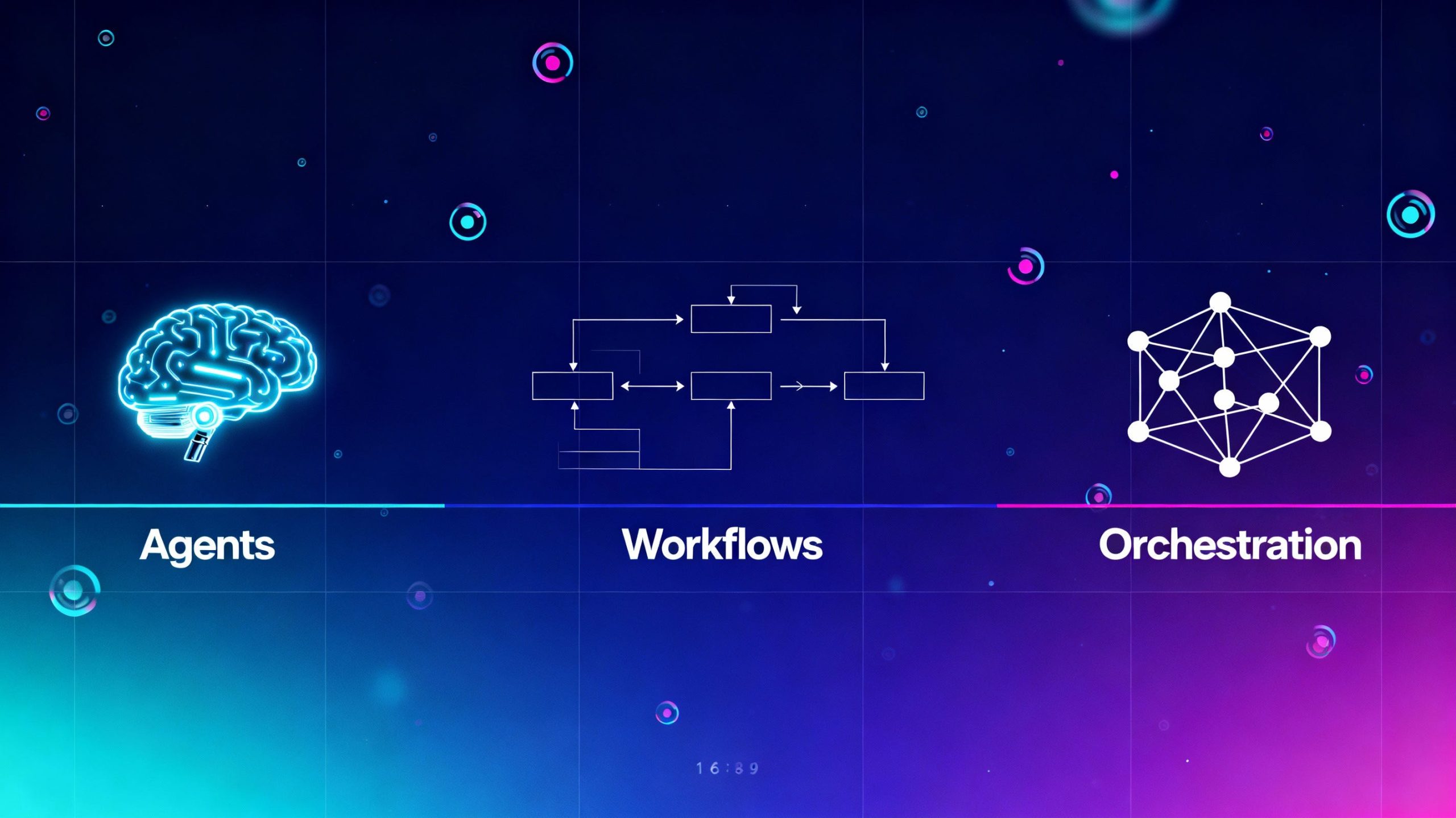
Generative AI has moved beyond single prompt responses into systems that can reason, plan, and act across multiple steps. Large Language Models are no longer just text generators. They are becoming orchestrators that can call tools, maintain memory, and coordinate tasks with a level of autonomy that was previously difficult to achieve. This shift has given rise to LLM orchestration frameworks such as LangChain and CrewAI, which enable developers to design structured workflows rather than isolated interactions. Understanding how these workflows are designed is essential for building reliable, scalable, and context-aware AI applications.
From Single Prompts to Orchestrated Workflows
Early applications of generative AI relied on one-off prompts that produced immediate responses. While useful, this approach quickly showed its limitations when tasks required reasoning over time, interacting with external systems, or maintaining context across steps.
LLM orchestration introduces structure. Instead of a single prompt, workflows are broken into stages. Each stage has a clear purpose, such as data retrieval, reasoning, decision-making, or execution. Orchestration frameworks manage how information flows between these stages, ensuring that outputs from one step become inputs for the next.
This approach allows AI systems to handle complex tasks such as research synthesis, automated reporting, or customer support resolution. Learners exploring advanced AI systems, often through an ai course in mumbai, are increasingly exposed to these multi-step design patterns as the foundation of production-grade AI solutions.
Tool Use as a Core Capability
One of the defining features of modern LLM orchestration is tool use. Tools allow language models to interact with external systems such as databases, APIs, search engines, or calculation engines. Rather than relying solely on their internal knowledge, models can fetch real-time data, perform precise computations, or trigger actions in other systems.
Frameworks like LangChain provide abstractions for defining tools and deciding when the model should use them. The orchestration layer controls how tools are invoked, how results are interpreted, and how errors are handled. This makes AI systems more accurate and trustworthy, especially in enterprise contexts where decisions must be grounded in up-to-date information.
Effective tool orchestration requires careful design. Developers must define clear tool interfaces, constrain model behaviour, and ensure that outputs are validated before use. When done well, tool use transforms LLMs from conversational agents into practical problem-solving systems.
Memory and Context Management in AI Systems
Memory is another critical component of orchestrated AI workflows. Without memory, models treat each interaction as isolated, limiting their usefulness in long-running tasks. Orchestration frameworks introduce different types of memory to address this challenge.
Short-term memory helps maintain context within a single session, such as tracking previous steps in a workflow. Long-term memory stores relevant information across sessions, enabling personalisation and continuity. Some systems also implement summarised memory, where detailed interactions are compressed into key insights to manage token limits.
Designing memory effectively requires balancing relevance and efficiency. Too much memory can confuse the model, while too little can break continuity. Orchestration frameworks provide mechanisms to control what is stored, when it is retrieved, and how it influences reasoning. These design considerations are central to building reliable autonomous agents.
Autonomous Agents and Multi-Agent Collaboration
Autonomous agents represent the next stage of LLM orchestration. An agent is an AI entity that can plan tasks, select tools, evaluate outcomes, and iterate until goals are achieved. CrewAI extends this concept by enabling multiple agents to collaborate, each with a defined role and responsibility.
In a multi-agent setup, one agent may focus on research, another on analysis, and another on execution. The orchestration layer manages communication, task delegation, and conflict resolution. This mirrors human team structures and allows complex problems to be tackled more efficiently.
Designing such systems requires careful coordination. Clear role definitions, shared context, and robust stopping conditions are essential to prevent infinite loops or conflicting actions. As these patterns mature, they are becoming a key topic in advanced learning pathways, including specialised modules within an ai course in mumbai.
Practical Design Considerations and Challenges
While LLM orchestration offers powerful capabilities, it also introduces challenges. Workflow complexity can grow quickly, making systems harder to debug and maintain. Latency may increase as multiple steps and tool calls are executed. There are also governance concerns, such as controlling model behaviour and ensuring compliance with organisational policies.
Best practices include modular design, extensive logging, and precise evaluation metrics. Testing workflows step by step helps identify weak points early. Human-in-the-loop mechanisms can also provide oversight for high-stakes decisions.
Conclusion
Generative AI is evolving from isolated language models into orchestrated systems capable of reasoning, acting, and collaborating across multiple steps. Frameworks such as LangChain and CrewAI enable this evolution by providing structured approaches to tool use, memory management, and autonomous agent design. By understanding these orchestration principles, developers can build AI applications that are more reliable, adaptable, and aligned with real-world needs. As adoption grows, mastery of multi-step LLM workflows will become a defining skill in the next generation of AI development.